
Ofsted rated Slough children's services inadequate on all four measures: children left in unsafe situations, some seriously harmed. What the report found.
Ofsted has rated Slough’s children’s social care services inadequate on all four measures, in a report that says children have been left in unsafe situations for too long and that some have been seriously harmed. (Ofsted inspection report, published 25 August 2026)
Inspectors were in Slough from 6 to 17 July. The lead inspector was Claire Beckingham, His Majesty’s Inspector. The services are run by Slough Children First, a company set up in April 2021 and owned by Slough Borough Council.
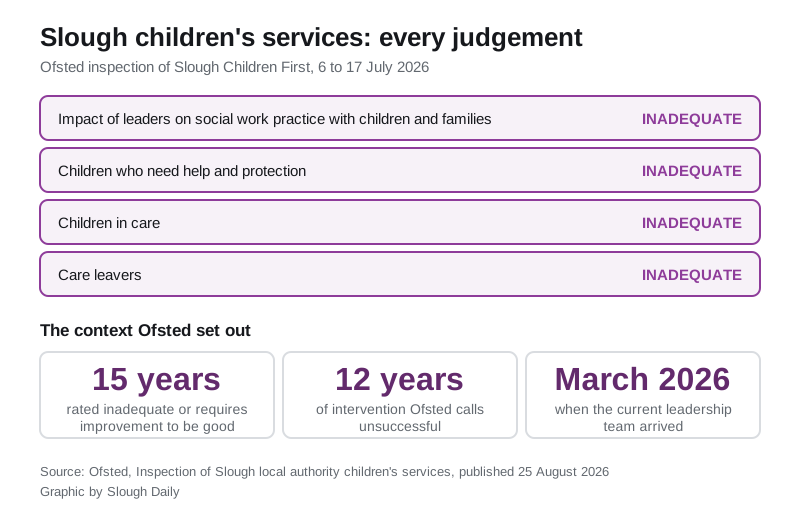
The four judgements are:
- The impact of leaders on social work practice with children and families: inadequate
- The experiences and progress of children who need help and protection: inadequate
- The experiences and progress of children in care: inadequate
- The experiences and progress of care leavers: inadequate
The report is blunt about the direction of travel. “Since the last ILACS inspection in 2023, the service provided to children has deteriorated,” it says. “Widespread and serious weaknesses in Slough’s help and protection services result in children being left in unsafe situations for too long, with some being seriously harmed.”
Fifteen years, and twelve years of intervention
The finding that will land hardest locally is not about July 2026. It is about how long this has gone on.
Ofsted records that Slough “has been judged to provide services that are inadequate or require improvement to be good for 15 years, meaning that many care leavers have had a poor experience of their corporate parent for their whole care journey.”
On the government’s involvement, the report is equally direct: “The last 12 years of intervention have been unsuccessful in achieving lasting change for the children and families of Slough. Multiple leaders have not been able to sustain improvements.”
Inspectors also say the improvement machinery has become part of the problem. Slough “experiences significant intervention from advisers and commissioners with activity competing for leaders’ attention”, and the improvement work “has become cumbersome and is not being managed in a way that enables leaders to concentrate on the improvements needed to frontline practice.”
What inspectors found
The findings run to 56 numbered paragraphs. Among them:
- Care leavers. After a focused visit in November 2025, Ofsted issued an area for priority action because a significant number of cases for 18 to 21-year-old care leavers had been closed prematurely. Eight months on, inspectors found “there remains a lack of clarity about who is entitled to services”, and that the council had not kept contact with care leavers in custody, homeless care leavers and others who needed help.
- Money. Some care leavers “miss meals to pay for travel to education because they are not aware they are entitled to financial support”. Others waited months for payments they were owed, because of what the report calls convoluted administrative processes.
- Housing. Weak housing planning leaves some young people in accommodation that is “unsuitable, unsafe, unhygienic and failing to meet basic standards”. Some care leavers missed years of being registered for social housing because staff did not understand the process.
- Children in unregistered homes. Children living in illegal, unregistered children’s homes “are not adequately safeguarded”, and some remain in those placements longer than necessary.
- Early help. Some families are put on a waiting list for early help. Leaders have increased capacity and cut the list, but “too many families are still not receiving support”, with limited oversight of anyone waiting.
- Disabled children. Staffing pressures mean assessments, plans and reviews are not always up to date, and indicators of harm are not always treated as a child protection issue.
- Private fostering. Children have been left in unassessed arrangements “with no oversight or support”.
- Children missing education. Leaders have no accurate picture of children missing education or electively home educated, so “leaders are not well sighted on who the most vulnerable children are”.
- Schools. Professionals in schools “speak in stark terms about a long-standing and systemic lack of faith in thresholds and children’s social care responses to abused and neglected children or families in crisis.”
- Scrutiny. “There is no children’s scrutiny board in the council and elected members have not developed firm plans to implement this.”
Ofsted’s list of what must improve runs to six points:
- identifying and serving the most vulnerable children and care leavers, including those being exploited, disabled children, children in private fostering, children in unregistered homes and homeless care leavers
- applying thresholds so people are helped at the right level
- the timeliness of safeguarding responses to abuse, harm and exploitation
- the quality and timeliness of children’s and care leavers’ plans, including permanence and transition planning
- oversight and scrutiny by corporate leaders
- the capacity of practitioners and managers to meet need across teams
What Ofsted praised
The report is not uniformly negative, and the strongest passages are worth setting out plainly.
- The Virtual School. Inspectors describe it as “highly effective”, with a robust personal education plan process, children’s voices central to decisions, and a “high number of care leavers in higher education and attending university”.
- Fostering. The service “provides largely safe and stable care”, and foster carers feel respected by it.
- Adoption. Assessments are “comprehensive, analytical and child focused”, with a strong emphasis on identity and therapeutic support.
- Unaccompanied asylum-seeking children generally receive a stronger service, in stable homes with thorough planning for independence.
- Homelessness services for 16 and 17-year-olds have improved since the last inspection, with joint housing assessments and a routine offer of advocacy.
- Missing and exploited children still living with their families mostly get responsive work, and the RISE adolescent service is described as impactful.
Inspectors also record that the leadership team appointed in March 2026 identified the full extent of the problems themselves, and that the council’s own self-evaluation is “unerringly accurate”. Improvement plans are in place but “all are in their infancy, and it is too early to assess their impact”.
What the council says
Councillor Puja Bedi, lead member for children, apologised. “This report is highly critical of how the service has been and, on behalf of the council, I want to apologise for not doing well enough for all the children who have needed us,” she said. (Slough Borough Council, 25 August 2026)
She pointed to high demand, very high caseloads and senior staff turnover, and said the new management team “have already started putting plans in place for improvements across the board”.
Councillor Wal Chahal, leader of the council, said: “These are not new issues; these services have been rated inadequate or requiring improvement for 15 years. That is a generation of children who have been let down.”
What happens next, and how to watch it
The Corporate Parenting Panel meets in public on Thursday 3 September at 5.30pm in the Council Chamber at Observatory House, 25 Windsor Road, SL1 2EL. (Agenda, Slough Borough Council)
Three items are taken in public:
- the safeguarding allegations process
- an update on health, including initial health assessments, immunisations, mental health waiting lists, dental health and CAMHS
- an update on the Virtual School, including how many young people are going to university
The press and public are then excluded for the rest of the meeting.
The safeguarding allegations report was added late, on 25 August, the day the Ofsted report came out. The frontsheet notes only that “item 3 was not available for publication with the rest of the agenda”.
It covers the Local Authority Designated Officer, the LADO, which is the role that handles allegations against adults who work with children. Ofsted’s verdict on that service is one of the harshest lines in the report: “The LADO service is not operating as an effective or sufficiently assured safeguarding function,” with “considerable weaknesses in recording systems and quality assurance”.
The report going to the panel, written by the registered manager of Foster with Slough, contains numbers the Ofsted report does not:
- 275 LADO referrals and contacts in 2023-24, of which 15 (5.5%) related to foster carers, in-house and agency
- 6 allegations against Foster with Slough carers in 2025-26
- Nationally, 2,860 allegations were made in England in 2024-25 against 4.9% of registered foster carers
It also concedes the timescale problem. The national expectation is that 80% of cases are resolved within one month and 90% within three. “For many foster carers and their families this is not the experience,” the report says. “The length of time taken affects their health and their finances, and affects children looked after whether remaining in the foster home or removed elsewhere.”
What it means for you
If you are worried about a child in Slough, do not wait for the improvement plan. Slough Children First’s Referral and Assessment Service takes concerns on 01753 875362, or by email at sloughchildren.referrals@sloughchildrenfirst.co.uk. (Slough Children First contacts) If a child is in immediate danger, call 999.
If you are a care leaver aged 18 to 25 and your case was closed, this report says you may have been entitled to services you did not receive. Ofsted found the council “has still not contacted many of those care leavers aged 18 to 25 to whom support was ceased”. You can ask to be reassessed through the same contacts.
If you are a foster carer facing an allegation, the process is set out in the report going to Thursday’s meeting, including the 24-hour timescale for an allegations meeting and the decisions that meeting can reach.
If you want to hold this to account, the Corporate Parenting Panel meeting on 3 September is public, and the panel next meets on 13 October. Ofsted’s finding that Slough has no children’s scrutiny board is the sort of thing councillors can be asked about directly.
We have also covered the censure of a Slough councillor over his treatment of a local business and the rebuild of the borough’s housing register, which everyone on the list must re-apply to by November. For the wider picture, see our pages on planning in Slough and Slough house prices.
Have your say