
Slough's average A-level point score rose to 36.22 in 2026, taking the borough's average grade from C+ to B-. Plus the deadline to challenge a grade.
Slough’s average A-level point score rose from 34.99 in 2025 to 36.22 in 2026, a fourth consecutive annual increase, and the borough’s average grade moved up a band from C+ to B-. Seventy per cent of schools in the borough improved their average point score per entry on last year. (Slough Borough Council, 13 August 2026)
Cllr Puja Bedi, the council’s lead member for children and lifelong learning, said the results showed “progress” and told students their “hard work, resilience, and determination have paid off. Whether you are heading to university, starting an apprenticeship, or entering the workforce, you should be incredibly proud of what you have achieved.”
What 36.22 actually measures
Average point score is the Department for Education’s headline 16 to 18 attainment measure, and it is not a pass rate. Every A-level grade is worth a fixed number of points in the performance tables: A* is 60, A is 50, B is 40, C is 30, D is 20 and E is 10, with a fail worth nothing. Because each grade is ten points apart, one point equals a tenth of a grade.
That makes Slough’s year-on-year movement of 1.23 points worth a little over a tenth of a grade per entry, and it puts the borough’s 36.22 between a C and a B on the scale. The council reports the resulting average grade band as B-, up from C+ in 2025.
Two things the council’s statement does not publish are worth saying plainly: it gives no school-by-school breakdown and no number of entries behind the borough figure, so the average is not weighted in any way a reader can check. It also covers schools, not the borough’s further education provision.
How the national picture moved
The official statistics for the whole of England came out on results-day morning from Ofqual, and they moved very little. Across England, 28.3% of A-level results were graded A or above in 2026, against 28.2% in 2025, and 78.1% were graded C or above, against 77.7%. In the South East, which includes Slough, 31.5% of the region’s 166,940 results were at A or above and 79.5% at C or above, both within a fraction of last year. (Ofqual, Qualification results in England summer 2026, table 8)
So a rise in Slough’s average grade is not simply national grade movement washing through. Nationally the needle barely twitched.
Why one school’s percentage will not match another’s
Every August, sixth forms publish a headline percentage and readers try to line them up. Mostly they do not line up, for two reasons.
First, schools choose their own measure. Some publish A to B, some A to C, some A to E, and many say “including equivalents”, meaning BTECs and other level 3 qualifications are folded in. Ofqual’s tables count A-levels only, and report just two thresholds: A and above, and C and above. A school’s A to C figure is roughly comparable with Ofqual’s C and above; an A* to B figure has no national equivalent at all, so it can only be set against that same school’s previous years.
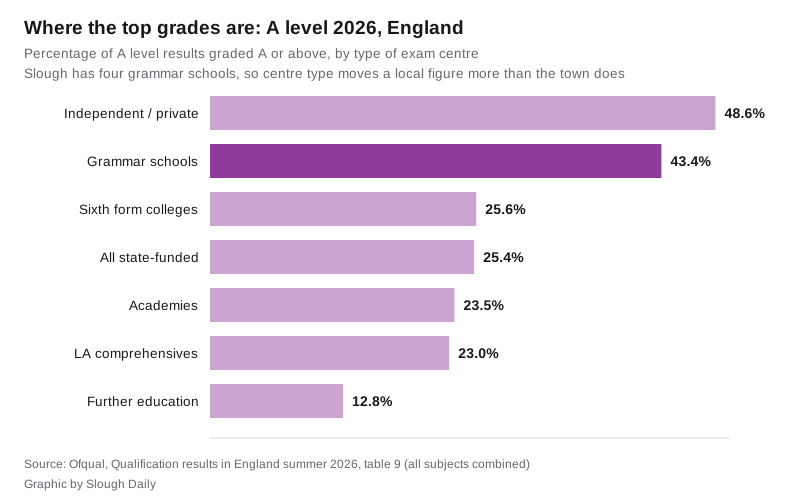
Second, the type of centre changes the number far more than the town does. In 2026, 43.4% of grammar school entries were graded A or above, against 25.6% at sixth form colleges, 23.5% at academies, 23.0% at local authority comprehensives and 12.8% at further education establishments. Independent schools reached 48.6%, and every state-funded centre type taken together came to 25.4%. Slough has four grammar schools, so any borough-level figure that mixes centre types together is comparing schools that select on ability at 11 with schools that do not.
The same trap sits inside Ofqual’s own interactive map of results by local area. Grades on that map are, in Ofqual’s words, “assigned to geographical areas based on the postcodes recorded for exam centres”, so a district ranks on the schools sitting inside it, not on where the students live. Slough’s grammar schools admit pupils from well beyond the borough boundary.
What it means for you: two weeks to question a grade
If a result looks wrong, the clock is already running. The dates for summer 2026, from the Joint Council for Qualifications, are:
- 20 August 2026: deadline for a priority review of marking, which is for A-level, T-level and level 3 vocational results only and is intended for students with a university place at stake. The outcome comes back within 15 calendar days.
- 24 September 2026: deadline for a standard review of marking, returned within 20 calendar days, and for a clerical re-check, returned within 10.
Three things families regularly get wrong about the process. The request goes through the school or college exams officer, not direct to the exam board, unless the student sat the exams privately. Written consent from the student is required before a centre can ask. And there is no grade protection: a review can lower a grade as well as raise it, so it is worth asking the school what the marks looked like before requesting one. An appeal to the exam board is only possible after a review has been completed.
For students who did not get the place they wanted, Clearing is open through UCAS, and apprenticeship vacancies are listed on the government’s find an apprenticeship service.
GCSE results follow on Thursday 20 August.
More Slough information: planning news, house prices and trains to London.
Have your say