
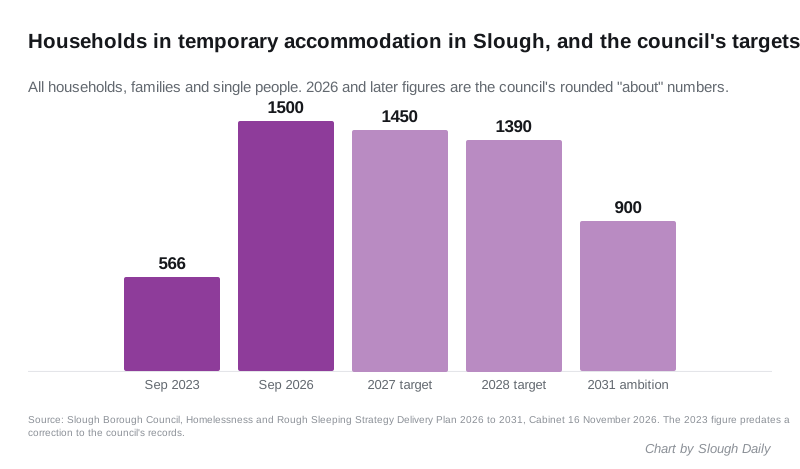
Around 1,500 Slough households are in temporary accommodation. A five-year homelessness strategy going to Cabinet on Monday aims to bring that down to 900 by 2031.
Slough Borough Council wants to cut the number of households in temporary accommodation from about 1,500 to 900 by 2031. The target is in its new Homelessness and Rough Sleeping Strategy, which Cabinet is asked to adopt on Monday 16 November.
The Cabinet report says 2,094 children were living in temporary accommodation in June 2026. Many had been there for long periods, and some were away from their schools and families.
Overview
- What: a five-year plan for preventing homelessness and reducing rough sleeping in Slough, with 39 actions.
- The headline target: about 1,500 households in temporary accommodation now, 900 by 2031.
- When: Cabinet meets at 6.30pm on Monday 16 November. The decision can be called in.
- Why now: the council’s last strategy covered 2019 to 2024 and has expired. The law requires a new one at least every five years.
The scale of the problem
An independent review by the consultancy Campbell Tickell, completed in May 2026, sets out where Slough stands. Its findings are summarised in the Cabinet report:
- 12.5% of households are overcrowded, more than three times the England average.
- In February 2026, fewer than 3% of private rented homes advertised in Slough were affordable at Local Housing Allowance rates.
- The end of a private tenancy caused 58% of homelessness presentations, nearly four times the national rate.
- Only 23% of prevention cases ended with a home secured for at least six months, against 52% in England.
- Only 22% of relief cases ended with a home secured, against 60% in England.
- Nightly-paid accommodation, the most expensive kind, rose from 33% to 84% of placements between September 2023 and September 2026.
Temporary accommodation is projected to cost £36.73m gross in 2026/27. Housing benefit only covers part of it, because the subsidy is tied to 2011 rent levels. That leaves a £21.405m gap for the council’s general fund this year, the report says.
The council’s commissioners, who oversee its finances under government intervention, backed the plan. They said delivery would need “sustained focus” given the size of those costs.
The targets
The Delivery Plan sets yearly targets. Most are measures the government now asks every council to report.
| What is measured | October 2026 | 2027 | 2028 | 2031 |
|---|---|---|---|---|
| All households in temporary accommodation | About 1,500 | About 1,450 | About 1,390 | 900 |
| Families with children in temporary accommodation | 1,026 | About 950 | 900 | Below 900 |
| Households helped to stay in their home or find a new one | 41% | 45% | 50% | At least 55% |
| People sleeping rough on a single night | 14 | 12 or fewer | 10 or fewer | 8 or fewer |
| People sleeping rough long term | 8 | 6 or fewer | 4 or fewer | 3 or fewer |
The plan also keeps a target of no family in bed and breakfast for more than six weeks, and no 16 or 17 year old in B&B at any time.
The council notes that part of the rise since 2023 reflects a correction to its records, when the true number in temporary accommodation was found to be much higher than recorded. The 2027 and 2028 targets still have to be agreed with the government.
What the council says is already working
The report lists changes made since 2024:
- 234 households were helped into private rented homes between October 2025 and September 2026.
- Since March 2026, no family has stayed in B&B for more than six weeks. Total B&B placements fell from 148 to 83.
- The backlog of homelessness assessments fell from 1,307 cases in January 2026 to 164 in September 2026.
- Rough sleeping halved in the annual count, from 36 people in 2024 to 18 in autumn 2025.
- £10.4m of government money is funding 49 temporary homes and nine homes for Afghan resettlement. Fifteen family homes at Rigby Lodge and Garrick House have been developed for temporary accommodation.
What residents said in the consultation
The draft was out for consultation from 1 September to 31 October. It drew 59 responses, 35 from individuals and 24 from organisations. Only eight of the individual responses came from, or on behalf of, people with experience of homelessness.
The vision was backed by 77% of individuals and 83% of organisations. The report says written comments were less about the plan’s direction than whether it can be delivered.
People with lived experience said they were told to “just private rent” when a low income, debt or no guarantor made that unrealistic. Others asked for face-to-face access, one reliable contact and regular updates on their case.
Two changes were made after the consultation:
- The strategy now commits to placing households in Slough wherever possible, and outside Slough only when necessary. The council says the guidance on out-of-borough placements will be published on its website.
- Support for landlords will lead with non-financial help, such as a single point of contact. Cash incentives, which only 62% of individuals supported, will be targeted where nothing else will secure a home.
What it means for you
If you are worried about losing your home, you do not have to wait until you have nowhere to go. Since the Homelessness Reduction Act 2017, the council counts you as threatened with homelessness from 56 days before it is likely to happen, and has a duty to take reasonable steps to prevent it. The strategy promises faster screening, a same-day response to urgent need, and more early advice in community hubs.
If you see someone sleeping rough, you can tell the outreach team through StreetLink, which the strategy names as part of its outreach work.
Cabinet’s decision will appear on the meeting page after Monday. The council will publish an annual progress report, and the Delivery Plan is to be refreshed every year.
Have your say