
Only 35.8% of Slough's children and young people meet the 60-minute daily activity guideline. The public health director's annual report says the town is falling behind.
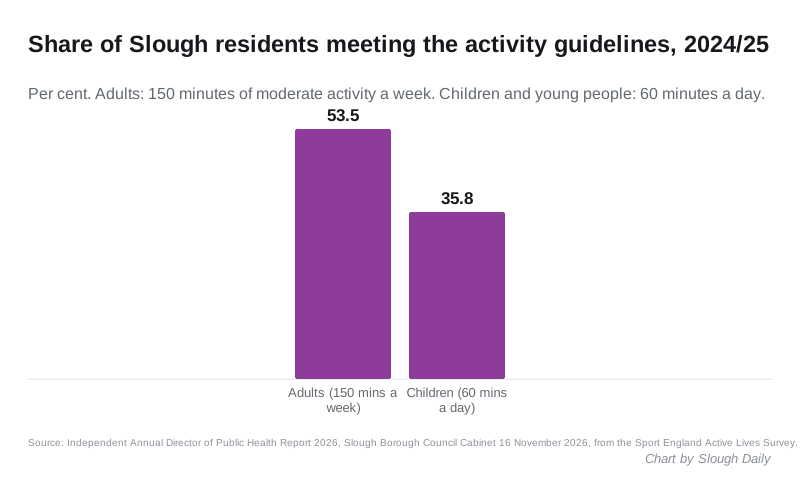
Only 35.8% of children and young people in Slough get the hour of activity a day that the guidelines recommend. That is the biggest gap with the national and regional rates in eight years, according to the Director of Public Health’s annual report.
The independent report, Physical Activity in Slough: Moving More Every Day, goes to the council’s Cabinet on Monday 16 November. The covering report asks Cabinet to endorse its recommendations.
Overview
- Children: 35.8% meet the 60-minutes-a-day guideline, a sharp fall in 2024/25 while the national rate rose.
- Adults: 53.5% meet the guideline of 150 minutes a week, and 21.5% do no physical activity at all.
- Comparison: Slough is less active than all of its statistical neighbours, for adults and for children.
- What is asked: Cabinet is asked to endorse six priorities. The report carries no new spending.
The figures
The report draws on Sport England’s Active Lives Survey for 2024/25. Its main findings for Slough:
- 53.5% of adults meet the Chief Medical Officer’s guideline of 150 minutes of moderate activity a week. The report says the gap behind England and the South East is wider than in previous years.
- 35.8% of children and young people meet the guideline of 60 minutes a day. The report calls this the largest gap with national and regional rates in eight years, “against a rising national trend”.
- 21.5% of adults say they do no physical activity at all. The figure is 14.6% in England and 12.1% in the South East.
Who is least active
The report says inactivity is uneven across the town:
- 58.2% of men meet the adult guideline, against 49.3% of women. That gap of 8.9 percentage points compares with 5.1 points nationally.
- 38% of boys are active, against 33% of girls.
- People in lower socio-economic groups are the most likely to be inactive, at 33%.
- 62 of Slough’s 84 small neighbourhood areas fall in the most deprived half of England.
It names affordability, cultural perceptions, access, time and feeling unsafe as the main barriers.
Why it matters
Healthy life expectancy in Slough is 58.1 years for men and 60.3 years for women. That is around five years and three and a half years below the England averages, the covering report says.
Men in Slough live to 77 on average but spend 19 of those years in poor health. Women live to 82 and spend 21 years in poor health.
The report also says Slough recorded the largest fall in male life expectancy of any local authority in Great Britain between 2017-19 and 2021-23. It fell by 2.1 years, against a national fall of 0.6 years.
What has worked locally
The report includes nine local examples. They include the Upton Court and Salt Hill junior parkruns, a beginners’ cycling programme for women in Britwell, and Berkshire Cricket Foundation’s Street Cricket.
It singles out the Viva Slough Neighbourhood Health Hubs, run with the SPINE primary care network. An evaluation of more than 100 participants found:
- inactivity fell from 21.6% to 2%
- the share active on four or more days a week rose from 25.8% to 57.6%
- 92% said they felt more confident about being active
The six priorities
Cabinet is asked to back six priorities for the council and its partners:
- focus first on the least active residents, including a “missing third” who use neither formal services nor traditional clubs
- make the active choice the easy one, through safer streets, better lighting and well-kept green space
- build activity into everyday life, from walking short journeys to movement in the school day
- fund community-led activity that fits local cultures
- use GP and NHS appointments to get people moving, with follow-up rather than just a leaflet
- set healthy habits early through PE and family activity
The report says the timing matters. The new Local Plan and a proposed Parks and Open Spaces Strategy will shape the town for a decade. A national £580m PE and School Sport Partnerships Network is due to launch in spring 2027.
What it means for you
Nothing changes on Monday: the report is for information and carries no direct spending. Its value is in how far its priorities shape the council’s later plans for parks, streets and leisure. Cabinet’s response will appear on the meeting page after Monday.
Have your say