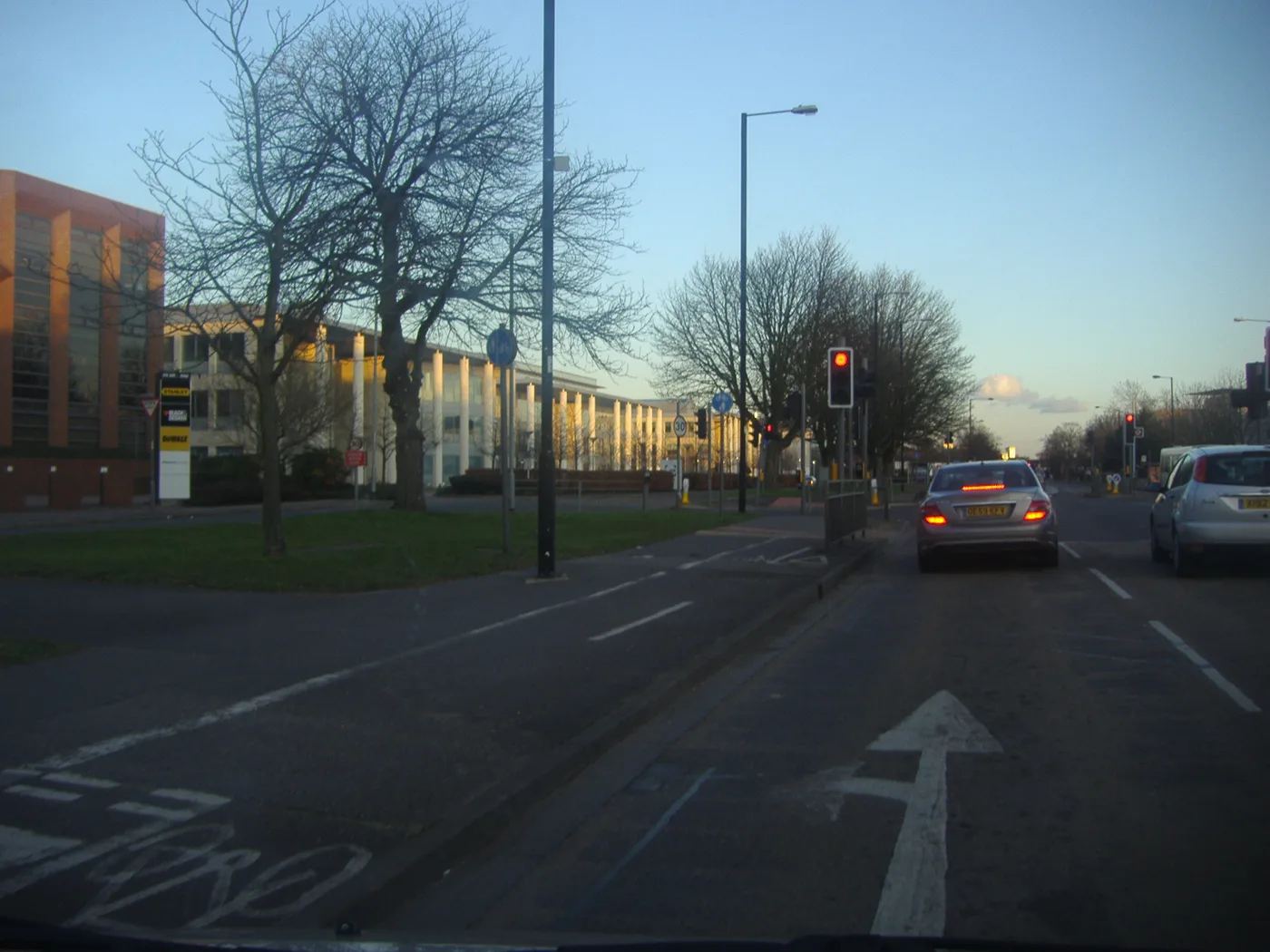
Thames Valley Police objected to Slough's A4 bus lane, warning of more injury collisions. The force raised no objection to the £10.4m cycleway now being built.
Thames Valley Police objected to Slough Borough Council’s A4 bus lane, warned that taking a lane away would push traffic onto residential streets, and told the council it expected “a rise in injury collisions along the length of the bus/cycle lane”. The force’s response is published in full in the council’s own Cabinet papers, and it is a good deal blunter than the summary most people ever saw.
Those papers matter again now. The council is spending £10.4m building a segregated cycle route along the same stretch of the A4, with works running on Bath Road until 2028. So we went back through the record to answer a straightforward question a Slough resident put to us: were the police warnings taken into account, and can you see that anywhere in public?
The short answer is that you can. The police objection was printed, answered line by line, and the answer the council gave in 2022 is, almost exactly, the scheme now being built. The force has since looked at that new scheme and raised no objection to it.
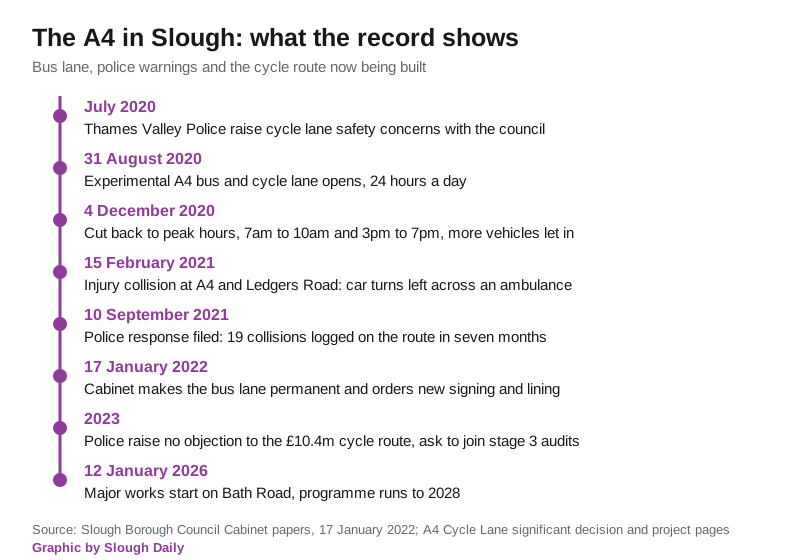
The bus lane itself opened on 31 August 2020, running in both directions and around the clock, paid for by the government’s Emergency Active Travel Fund and brought in under experimental traffic orders. From 4 December 2020 it was cut back to peak hours only, 7am to 10am and 3pm to 7pm on weekdays, and taxis, private hire vehicles, motorcycles, zero emission vehicles and hired e-scooters were allowed to use it alongside buses and cycles.
What the police actually said
The response was sent on 10 September 2021 by David Edmond, a traffic management officer in the Hampshire Constabulary and Thames Valley Police Joint Operations Unit, and is published as Appendix 1.7 to the Cabinet report. It opens by reprinting the force’s original objection to the scheme, made when it was proposed in 2020:
Traffic flows are creeping back up towards pre lockdown levels, between 60-70%, and this will only increase. Reducing the available space on the A4 will cause congestion and result in an increase in traffic using residential streets off the A4 to avoid queues caused by the bus/cycle lane.
I have concerns about traffic turning across the bus lane and coming into conflict with pedal cyclists. I think your proposal will bring about a rise in injury collisions along the length of the bus/cycle lane.
The 2021 response then sets out what officers had found after a year of living with it. On response times the force was even-handed: emergency journeys “have not unduly been affected”, because police vehicles are exempt. Routine journeys were another matter.
Officers are regularly delayed at peak times during bus lane operating hours caused by a reduction in the available road space, we feel this does affect their ability to travel around Slough.
The junction it singles out is Wellington Street where it meets Windsor Road and the High Street. The bus lane starts about 60 metres west of the junction, two A4 lanes filter into one at that point, and two more lanes join from the High Street, so “four lanes reduce to one within 60 metres of this junction”. The force says that is a main route for officers leaving the police station for the north, east and west of the town, and for the run to the custody suite in Maidenhead.
On driver behaviour, the force’s view was that the operating hours were not understood:
Officers perception is that the bus lane operating hours are not necessarily understood by the travelling public with comments that the majority of drivers use lane two, even when the bus lane is not in operation.
It also flagged “confusing signing on the eastbound A4 through Slough Trading Estate”, where road markings showed left turn movements from lane one that were wrong whenever the bus lane was not operating.
Two collisions are named. On 15 February 2021 there was an injury collision at the junction of the A4 and Ledgers Road, involving a car that turned left across the path of an ambulance travelling in the bus lane on an emergency response. On 7 April 2021 a pedestrian was killed on the A4. The officer’s account is of a speeding van undertaking slower vehicles that were in lane two at a time when they were legally allowed to use lane one.
The council’s own analysis, in the Cabinet report, describes that fatal collision differently in one respect, as an LGV travelling east to west colliding with a pedestrian crossing the carriageway, and records the contributory factors logged against it as exceeding the speed limit, careless or reckless driving, and failing to look properly. Officers analysed 19 recorded collisions on the bus lane route between 1 December 2020 and 30 June 2021: 15 slight, three serious and one fatal. Two of the 19 followed left turns by vehicles leaving the A4.
The force made a separate point about the cycle lane, which it had raised with the council in July 2020, before the bus lane opened:
We thought it was a confusing arrangement and were unclear as to whether it was an advisory cycle lane or a traffic lane raising concerns that it would be very difficult to prove fault in any collision involving a car and a pedal cycle in that area, this remains our view.
The day after that contact, the officer notes, the Department for Transport published Local Transport Note 1/20, the national cycle infrastructure design standard. His verdict: “I’m not sure this cycle lane has met either the old or new design standards.”
What the council said back
The police response was not buried. It is printed at length in the statutory consultees table in the Cabinet report, with the council’s answer alongside it, and the report went to Cabinet on 17 January 2022.
On congestion, officers compared 2019 and 2021 data from permanent traffic counters and Bluetooth journey time monitors and said journey time on the remaining all-traffic lane had not increased significantly. The largest increase they found anywhere was 2 minutes 57 seconds, on the 5.1 mile eastbound run from the Huntercombe Roundabout to M4 junction 5 in the evening peak, and they noted that the Wexham Road junction was a building site for part of that period.
On safety, the council promised to review signage and road markings, and to commission an independent Stage 3 Road Safety Audit, with remedial works if the audit found anything. On the cyclists point it was explicit: concerns “will be addressed through the A4 cycle lane design”. Officers said the cycle lane between the Huntercombe roundabout and Dover Road would be removed if the scheme was made permanent, because of LTN 1/20, and that a bid had gone in for capital funding for a segregated, LTN 1/20 compliant cycle lane along the A4 from Huntercombe Lane to Uxbridge Road.
Cabinet agreed to make the experimental orders permanent, to let green number plate vehicles use the lane, and to approve “additional works including signing and lining to be undertaken to improve road safety”. A total of 862 responses had been received in the objection period, 508 of them raising congestion and 236 raising road safety.
The bid became the scheme now on Bath Road
That funding bid succeeded. The council was awarded £10.4m by the Department for Transport and Active Travel England to design and build an LTN 1/20 compliant segregated cycle lane from the Huntercombe crossroads to Uxbridge Road, which is the A4 Cycle Lane scheme now under construction. It is the same route, to the same standard, that officers named in answer to the police in 2022.
Thames Valley Police was consulted on it. The council’s significant decision report records the force’s response to the 2023 consultation under four points: no objection to the proposal; a welcome for the chance to support schemes that encourage road safety; a request to be kept informed of any developments or alterations; and a request “to be involved in any stage 3 Road Safety Audits”.
A second Thames Valley Police response in the same appendix says the scheme “seems well thought out” and should benefit cyclists and pedestrians, while calling the junction arrangements complex, questioning why the route has to cross the road where it meets Buckinghamshire’s cycle route west of Huntercombe Lane, and adding that officers hope the new lane is “sufficiently respected by other road users”, because the current shared cycle and bus lane has produced “resentment and harassment by car drivers to cyclists”.
The report also notes that the design will go through a cycle audit and Road Safety Audits at stages 1, 2 and 3. Turnout at the 2023 consultation was thin: 201 responses, and 16 people in total across three drop-in sessions.
What is not in the public record
Three things we could not find published anywhere. Whether the Stage 3 Road Safety Audit on the bus lane, promised to Cabinet in January 2022, was carried out, and what it said. Whether the cycle lane between the Huntercombe roundabout and Dover Road was in fact removed as officers said it would be. And whether Thames Valley Police has been given a place on the Stage 3 audits for the current scheme, as it asked.
A Slough resident, who asked not to be named, has put those questions to the council. They tell Slough Daily they submitted a request under the Environmental Information Regulations 2004 on 1 September 2026 to freedomofinformation@slough.gov.uk, copied to the transport planning and street works teams, and that the council replied the next day citing section 8(1)(b) of the Freedom of Information Act and asking for more information about their name before it could be logged. They say they replied that the request was made under the Environmental Information Regulations, not the Freedom of Information Act, and asked for it to be processed as submitted.
The regulations allow 20 working days, extendable to 40 for complex requests. On a request made on 1 September, that ordinary deadline falls on 29 September 2026. We have asked the council the same questions and will publish what comes back.
What it means for you
Bath Road is a building site for the next two years and the published programme runs to 2028. The council’s traffic management page gives provisional dates: Huntercombe Lane crossroads to Goldsworthy Way from 12 January to 31 March 2026; St Andrews Way to Elmshott Lane and Station Road from July to November 2026; Elmshott Lane to Burnham Lane from November 2026 to May 2027; Tuns Lane to Montem Lane from November 2026 to May 2027; Burnham Lane to Dover Road from April to July 2027; Montem Lane to Stoke Poges Lane from May 2027 to March 2028; Dover Road to the Pitts Road crossing from June 2027 to April 2028; and Stoke Poges Lane to Wexham Road from March to May 2028. The council says the programme may change and that traffic management plans can change at short notice.
Some of the congestion the police warned about in 2021 is being managed by hand during the works. The council’s updates page records that on 16 July it put eastbound and westbound movements at the Three Tuns junction back to how they were before, to tackle congestion, that traffic signal timings in the area were being adjusted, and that the bus lane between Salt Hill Way and Metro Bank would be suspended, with signage, while it considered suspending others.
If you drive, cycle or catch a bus on the A4, that updates page is the one worth checking before you travel, and you can get the council’s monthly scheme newsletter by emailing transportplanning@slough.gov.uk. Our own Slough roadworks and travel page carries the rest of the borough’s closures, and the planning news page tracks the decisions behind schemes like this one.
If you have photographs of the works, of the queues or of the lane markings, or documents on this corridor, send them to us and they go into the reporting.
Sources
- Appendix 1.7, Response from Thames Valley Police, 10 September 2021
- Appendix 1.3, Anonymised consultation responses
- A4 Experimental Bus and Cycle Lane, Cabinet report, 17 January 2022
- Cabinet decision, A4 Experimental Bus and Cycle Lane
- Significant Decision, A4 Cycle Lane
- Slough Borough Council, A4 Cycle Lane
Have your say