
Slough Borough Council received 1,498 complaints in 2025/26, up from 960. Cabinet is asked on Monday to agree a review and a simpler way to complain.
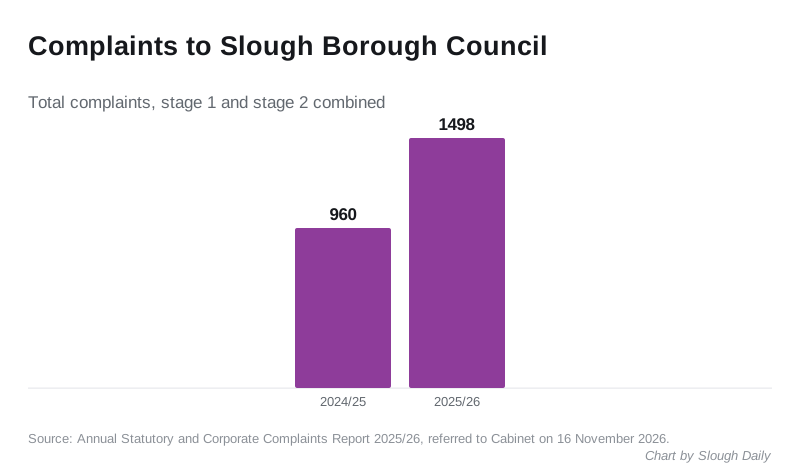
Complaints to Slough Borough Council rose by 56% in a year, from 960 in 2024/25 to 1,498 in 2025/26. Cabinet is asked on Monday 16 November to accept a set of recommendations from the council’s own audit committee about the rise.
The figures are in the annual complaints report, which the Audit and Corporate Governance Committee considered on 30 September and referred to Cabinet.
Overview
- Total complaints: 1,498 in 2025/26, up 56% from 960.
- Where they came from: mostly homelessness and temporary accommodation, housing repairs and estates, and council tax and benefits.
- Main causes: poor communication, delays, and nobody clearly owning a case.
- What Cabinet is asked to do: agree a review of what has been done, look at making complaining simpler, and report back in March 2027.
The figures
| Measure | 2024/25 | 2025/26 |
|---|---|---|
| Total complaints | 960 | 1,498 |
| Stage 1 complaints | 819 | 1,209 |
| Stage 2 complaints (escalated) | 141 | 289 |
| Stage 1 answered on time | 46% | 66% |
| Stage 2 answered on time | 42% | 50% |
| Stage 1 complaints upheld | 71% | 52% |
| Stage 2 complaints upheld | 61% | 56% |
| Ombudsman investigations | 17 | 17 |
Escalated complaints more than doubled. The share of stage 1 complaints settled without escalation fell from 82.8% to 76.1%.
Complaints were answered faster, though. The share of stage 1 replies sent on time rose by 20 percentage points.
Which services drew the complaints
The report says the rise is driven by a small number of high-demand services:
- Homelessness and temporary accommodation: demand for assessments and accommodation, and applicants not being kept informed about their case.
- Neighbourhood services: delays to repairs, tenancy and estate problems, and anti-social behaviour cases.
- Revenues and benefits: administrative and processing errors, and slow updates to customers.
The council also says part of the rise comes from making complaints easier to record and to make, so more are now formally logged.
The Ombudsman
The report says the chief executive and the monitoring officer have met the regional officer of the Local Government and Social Care Ombudsman. The meeting was about “the Council’s failure to respond in a timely manner to ombudsman investigations and to implement agreed recommendations”. Those concerns mainly relate to complaints about special educational needs and disabilities (SEND). Quarterly meetings with the Ombudsman will continue.
The commissioners overseeing the council said the volumes and uphold rates “suggest recurring service failures and communication problems”. They said the issues point to wider performance problems across key council functions, not only how complaints are handled.
What Cabinet is asked to agree
The council proposes to accept all four of the committee’s recommendations:
- note the committee’s concern about the 56% rise
- review whether the measures already taken have made a difference
- look at simplifying the complaints process, so people know who is handling their case and do not have to keep chasing
- bring a progress report back to the committee in six months, at its March 2027 meeting
What it means for you
The council’s complaints process has two stages. If you are unhappy with the stage 1 reply, you can ask for the complaint to be escalated to stage 2.
If you are still unhappy after that, you can go to the Local Government and Social Care Ombudsman. Council tenants with a housing complaint go to the Housing Ombudsman instead.
Cabinet’s decision will appear on the meeting page after Monday.
Have your say