
Government intervention at Slough council now runs to 30 November 2029 under a new team led by John Coughlan. Fees run up to £928,000 a year, paid by the council.
The government has confirmed that Slough Borough Council will stay under intervention until 30 November 2029, with a new team of commissioners in charge. The new legal Directions were made on Wednesday 25 November and took effect straight away.
The decision was announced in a letter from the local government minister, Baroness Taylor of Stevenage, to the council leader, Councillor Wal Chahal (MHCLG, letter to the Leader of the Council, 25 November 2026). The Directions of November 2024, which were due to expire on 30 November, are revoked.
It means Slough will have been under government intervention for eight years. Commissioners were first sent in on 1 December 2021.
Who is on the new team
Four commissioners and a political adviser were named. The government’s explanatory memorandum describes their backgrounds (Explanatory Memorandum, 25 November 2026):
| Role | Name | Background, as the government describes it | Nominated until |
|---|---|---|---|
| Lead Commissioner | John Coughlan | Experienced council chief executive with children’s services improvement experience | 30 November 2029 |
| Managing Director Commissioner | Dr Dave Smith | Former chief executive of the South Yorkshire Mayoral Combined Authority | 25 May 2028 |
| Finance Commissioner | Debra Warren | Former chief executive and finance chief at the Royal Borough of Greenwich; current Finance Commissioner in Croydon | 30 November 2029 |
| SEND and Children’s Services Commissioner | Steve Crocker | Former chief executive of Hampshire County Council | 30 November 2029 |
| Political Advisor | Councillor William Nunn | Vice-chairman of Breckland Council and a Local Government Association peer | Not stated |
The end dates come from each person’s appointment letter (MHCLG, commissioner appointment letters, 25 November 2026).
Dr Smith is the only member of the outgoing team to stay. He has been the council’s chief executive since August, as we reported in October. His appointment letter says the role is “equivalent to that of the Authority’s Chief Executive”.
Mr Crocker is appointed jointly by the housing ministry and the Department for Education. Until now, the council and its children’s services were overseen as two separate interventions. The government calls the new set-up “one intervention”.
The political adviser is new. He “will not hold the powers of Commissioners”, his letter says. His job is to work with the council leader and councillors. Every council seat is up for election in May 2027.
The minister thanked the departing commissioners, Gavin Jones, Kim Wright and Denise Murray.
What the commissioners control
Most decisions stay with councillors, the minister’s letter says, “but with the oversight of the Commissioners”. The commissioners can take over these functions:
- governance and scrutiny of the council’s big strategic decisions
- the council’s finances, including budget setting, borrowing and debt repayment plans
- proposing changes to a budget they think puts the council at risk
- hiring and firing the council’s statutory officers, such as the finance chief
- the shape of senior management and who is recruited to it
- appointing directors of council companies, apart from Slough Children First
- redesigning how services are run, to save money
The council, in turn, must put an improvement and recovery plan in place. Full council has to consider it at least once every three months. It has to cover children’s services, SEND and housing, a debt repayment plan, and support for the councillors elected in May 2027.
What it costs, and who pays
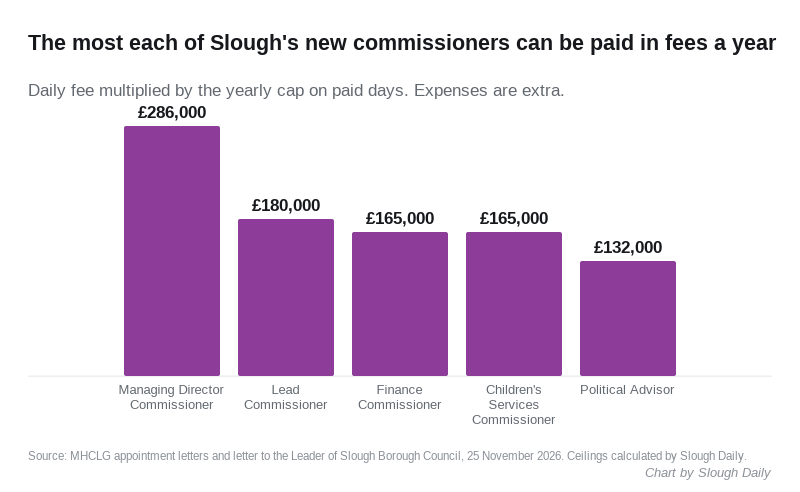
The council pays the commissioners’ fees and expenses. The minister has set these daily rates (MHCLG, letter to the Leader of the Council, 25 November 2026):
| Role | Fee per day | Most paid days a year | Most in fees a year |
|---|---|---|---|
| Lead Commissioner | £1,200 | 150 | £180,000 |
| Managing Director Commissioner | £1,100 | 260 | £286,000 |
| Finance Commissioner | £1,100 | 150 | £165,000 |
| Children’s Services Commissioner | £1,100 | 150 | £165,000 |
| Political Advisor | £1,100 | 120 | £132,000 |
The final column is our own sum of the rate and the cap. If every member worked every day allowed, fees would reach £928,000 a year, before expenses. The caps can only be exceeded with the Secretary of State’s approval.
What the council said
The council did not oppose the extension. In its formal response, dated 27 October, Cllr Chahal wrote that the council “acknowledges that it is not yet fulfilling its Best Value duties and as such accepts the need for continuing support” (Slough Borough Council, representation, published 25 November 2026).
He welcomed the move to a single team. He also wrote that the council “has some distance to go”.
According to the memorandum, one other councillor, a Conservative, also wrote in. That councillor supported the extension and the new political adviser role.
What happens next
- The commissioners must report to the government within six months, then every six months.
- The minister intends to review progress after twelve months.
- The government has “not ruled out” handing more powers to the commissioners, or appointing more of them.
- The Directions run until 30 November 2029 unless the Secretary of State ends them sooner.
What it means for you
Bins, council tax collection, planning and libraries carry on as normal. The decision does not by itself change council tax.
What changes is who has the last word on the council’s money and its top jobs. That will matter most when the 2027/28 budget is set early next year. The council is forecasting an overspend of around £20m this year, and its Cabinet approved draft savings for 2027/28 on 16 November.
The commissioners’ fees come out of the same council budget that pays for services. We set out the background in our report on the proposed extension in October.
Have your say