
Ministers plan to keep commissioners at Slough council until 30 November 2029, three more years. The external review and what changes for residents.
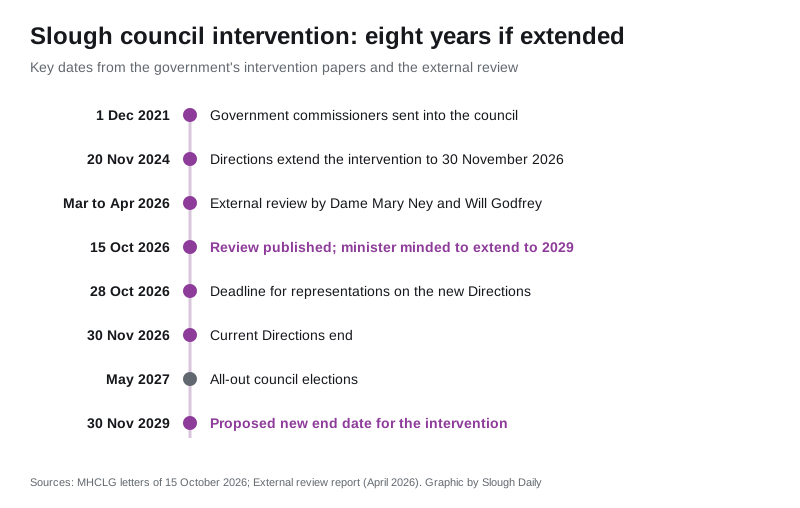
The government plans to keep Slough Borough Council under intervention for three more years, until 30 November 2029. The current arrangements were due to end on 30 November this year.
The local government minister, Jim McMahon, set out the plan in a letter to the council leader, Councillor Wal Chahal, on 15 October. He wrote that he had “concluded that the Authority is not yet meeting its Best Value Duty” and that stepping back now “would bring a significant risk to your Authority’s recovery” (MHCLG, letter to the Leader of the Council, 15 October 2026).
The decision is not final. The minister says he is “minded to” issue new Directions, and invited the council to respond by Wednesday 28 October. A final decision will be announced after that. The council has not published its response.
If the plan goes ahead, Slough will have been under government intervention for eight years. Commissioners were first sent in on 1 December 2021.
A new commissioner team
The government is proposing one team covering both the council and children’s services, which until now have been run as two separate interventions. It would have:
- a Lead Commissioner
- a Managing Director Commissioner
- a Finance Commissioner
- a SEND and Children’s Services Commissioner, appointed jointly by the housing and education departments
- a political adviser to support councillors
In a separate letter, the minister told the commissioners that the two departments’ approach had “been too fragmented to date” (MHCLG, response to the commissioners’ eighth report, 15 October 2026).
Under the draft Directions, commissioners would keep control of the council’s strategic financial decisions, the appointment and dismissal of its statutory officers, and the structure of its senior management. The council would have to bring an improvement and recovery plan to full council at least once a quarter.
What the commissioners found
The commissioners’ eighth report, published the same day, opens bluntly: “Slow and inconsistent progress at Slough Borough Council continues to be of significant concern.” It says the “step change” they called for in their seventh report “has not been achieved” (Commissioners’ eighth report).
The report credits better financial planning and fewer historic accounting problems. But it sets out how stretched the money still is:
| Measure | Figure |
|---|---|
| Forecast overspend for 2026/27, at quarter 1 | around £20m |
| General fund reserves, end of March 2026 | £27m, of which £11m unallocated |
| External debt, March 2026 | £470m |
| Exceptional Financial Support expected by March 2028 | £417m, cumulative |
| Households in temporary accommodation | more than 1,500, against a forecast of 1,300 |
Children’s services are the main cause of the overspend, the report says, with temporary accommodation the other big pressure. It warns that the £11m the council planned to put back into reserves this year “may not be achievable”.
What the external review recommended
The government also published the review it ordered in March, by Dame Mary Ney and Will Godfrey. They carried out the work between 5 March and 30 April (Report of the review into the Slough Borough Council intervention).
They found “a sense of general helplessness and fatigue within the council” and “an overreliance on Commissioners to be decision-makers”. They said the review had heard concerns from residents about the commissioners’ value for money.
Their answer was to extend the Directions, but with commissioners stepping back to an oversight role. The main recommendations were:
- a fixed-term senior management team, committed for around 18 months, aiming for exit from intervention “in two years”
- a political adviser to help councillors after the all-out elections in May 2027, when many long-serving councillors are standing down
- bringing children’s services back in-house from Slough Children First, the company that runs them, whose contract ends in November 2027
- government help with regeneration, housing and Heathrow expansion, including exploring a share of business rates from the airport
The review rejected a debt write-off, saying it “would set a very challenging precedent”. It also advised against merging Slough with neighbouring councils for now, calling reorganisation “an unwanted distraction”.
The review aimed for an exit “in two years”. The minister’s draft Directions would run for three.
The council tax option
One financial option in the review matters to every household. It says Slough’s council tax “sit[s] below those assumed in the Fair Funding Review 2.0”. It suggests allowing the council “to add 2% to their council tax level”, on top of the usual limit, as an option within its budget plan.
That is a suggestion to the government, not a decision. Neither the minister’s letters nor the draft Directions mention it. Any rise for 2027/28 would be set in the council’s budget early next year. Our Slough council tax bands page shows what each band pays now.
The review also suggests lengthening the assumed life of assets in the council’s debt repayment sums. It estimates that would cut annual debt costs by around £5m.
What the review got right about Slough
The report is not all criticism. The reviewers listed services working well:
- all nursery, primary and special schools rated at least good
- adult social care rated Good by the Care Quality Commission
- the Britwell Hub and the Langley Community Safety Project, each awarded £20m of Pride in Place money over ten years
What it means for you
Day-to-day services do not change. Bins, council tax collection, planning and libraries carry on as normal.
What changes is who has the final say on the big decisions until at least 2029. Commissioners would keep power over the budget, borrowing and senior appointments, and the council pays their fees and expenses.
The council’s children’s services overspend, debt and temporary accommodation pressures are the backdrop to next year’s budget. That budget will be the first test of whether the council tax option is taken up.
We first reported on the uncertainty in October, when the council’s chief executive was appointed only until 30 November. The auditor’s public interest report on the council’s accounts goes to full council on 26 November. We will report the government’s final decision when it is announced.
Have your say