
Auditors say Slough council failed its duty on accounts: seven years, 2018-19 to 2024-25, with no audit opinion. Councillors must debate it on 26 November.
Slough Borough Council has failed in its legal duty to publish timely and accurate accounts, its external auditor has concluded. Grant Thornton has used its strongest formal power, a report in the public interest, to say so.
The 45-page report, dated 28 October and published by the council on 29 October, covers the seven financial years from 2018-19 to 2024-25. The auditor could not give an opinion on the accounts for any of them.
“In short, a disclaimed opinion means the auditor gives no opinion on the financial statements and a reader of the accounts has no external audit assurance,” the report says. It adds that Slough “is unique in the scale of this backlog”.
What the auditor found
Grant Thornton puts the failure on the council as a whole, including its councillors. The report says political oversight “has not exercised sufficient political scrutiny and challenge” over the weaknesses in its finances.
Its main findings:
- No audit opinion for seven years. The 2018-19 accounts were disclaimed in November 2024. Every year from 2019-20 to 2024-25 then got a “backstop disclaimer”, because the draft accounts arrived too late to audit before the government’s legal cut-off dates.
- £188 million of corrections to the 2018-19 accounts. Revised accounts needed more than 50 separate adjustments, touching around 80% of the disclosure notes. Of the total, £155 million affected the balance sheet and £79 million the General Fund.
- A £33 million shortfall in debt repayment charges in 2018-19. The council had miscalculated its Minimum Revenue Provision, the sum it must set aside each year to repay borrowing, since 2016-17. Over the same period its borrowing rose from about £180 million to £760 million.
- £26 million of staff costs had been wrongly treated as capital spending, and were corrected.
- Five changes of chief finance officer since 2021, the post known as the Section 151 Officer, plus many interim appointments in other senior finance roles.
- Inadequate internal controls every year since 2020-21, according to the council’s own Head of Internal Audit. That officer gave “no assurance” for 2024-25 and “limited assurance” for 2025-26.
The report found no evidence that the errors in the 2018-19 accounts were fraudulent or deliberate. It also says it makes no criticism of any individual.
How late the accounts were
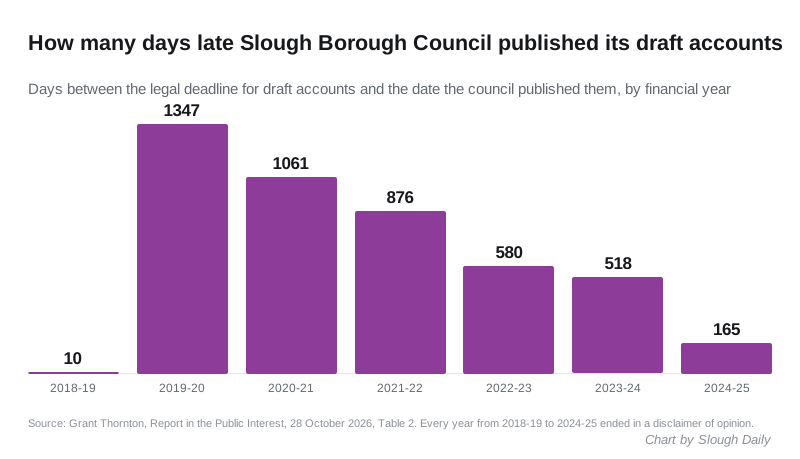
The table in the report shows how far behind the council fell. Draft accounts for 2019-20 were due by 31 August 2020. The council published them on 9 May 2024, more than three and a half years late.
| Year | Draft accounts due | Council published them | Days late | Audit opinion |
|---|---|---|---|---|
| 2018-19 | 31 May 2019 | 10 June 2019 | 10 | Disclaimer |
| 2019-20 | 31 August 2020 | 9 May 2024 | 1,347 | Backstop disclaimer |
| 2020-21 | 1 August 2021 | 27 June 2024 | 1,061 | Backstop disclaimer |
| 2021-22 | 1 August 2022 | 24 December 2024 | 876 | Backstop disclaimer |
| 2022-23 | 31 May 2023 | 31 December 2024 | 580 | Backstop disclaimer |
| 2023-24 | 31 May 2024 | 31 October 2025 | 518 | Backstop disclaimer |
| 2024-25 | 30 June 2025 | 12 December 2025 | 165 | Backstop disclaimer |
The two years before Grant Thornton took over, 2016-17 and 2017-18, were published on time and received clean opinions.
The report also recalls the restatement of the council’s 2023-24 results. In July 2025 full council was told that the outturn for that year was £14.75 million worse than previously reported. The causes included grant income counted twice and investments still on the books after they had been sold. The council then had to ask the government for more financial support, bringing its total request to £313.4 million by the end of 2023-24.
The four recommendations
The auditor made four new statutory recommendations. The council’s written responses, printed in the report, accept all four. In summary:
- Councillors must take a “clear and sustained grip” of financial management and reporting. The Audit and Corporate Governance Committee should enforce deadlines, and the Leader should make sure confidence in the stewardship of public money is restored.
- Statutory officers must rebuild core financial systems and controls so that accounts can be prepared properly.
- The council must set up a quality assurance framework so that accounts and their evidence are ready for audit on time, across central finance and every service.
- The council must agree a “clear and deliverable roadmap” with its auditors to restore audit assurance after seven disclaimed years.
These sit alongside statutory recommendations the auditor made in May and July 2021. The report says those “have resulted in limited improvements delivered to date”, despite an escalation letter to the chief executive in September 2024.
What the council says
The council leader, Councillor Wal Chahal, said the report covered a historical period. “Because of the section 114 notice in July 2021 and investigations and reviews then and since, there is nothing in the report which is new or surprising,” he said in the council’s statement.
He pointed out that the 2025-26 accounts were published by the 30 June 2026 deadline and are now being audited. The council cleared six years of outstanding accounts between April 2024 and February 2026. “We know there is much more to do,” he added.
Grant Thornton says the council has made “initial steps” by publishing its 2025-26 draft accounts on time. It says the audit opinion on 2025-26 “remains open”.
What happens next
The law gives the council one month to respond in public. It must hold a meeting, decide whether to accept the recommendations and say what it will do about them. That meeting is full council on Thursday 26 November 2026.
The report lands as the council’s government intervention nears a decision point. The Best Value Directions run to 30 November 2026, and a review led by Dame Mary Ney is expected to report in late 2026. Our story on the chief executive’s appointment explains what is due by then.
What it means for you
- Your council tax pays for a council whose books have not been audited since 2017-18. The auditor says that leaves residents, councillors and the government without reliable information to judge its decisions.
- It does not change your bill or your services today. Council tax for 2026-27 is set, and our council tax bands page has the current charges.
- You can watch the debate. Full council meets on 26 November and the papers will appear on the council’s meetings site about a week before.
- The money pressure has not gone away. The council is forecasting an overspend this year, mostly on children’s services.
Have your say