The RingGo parking fines petition closed on 2 September with 106 names, well below the 1,500 Slough needs for a full council debate. What happens to it now.
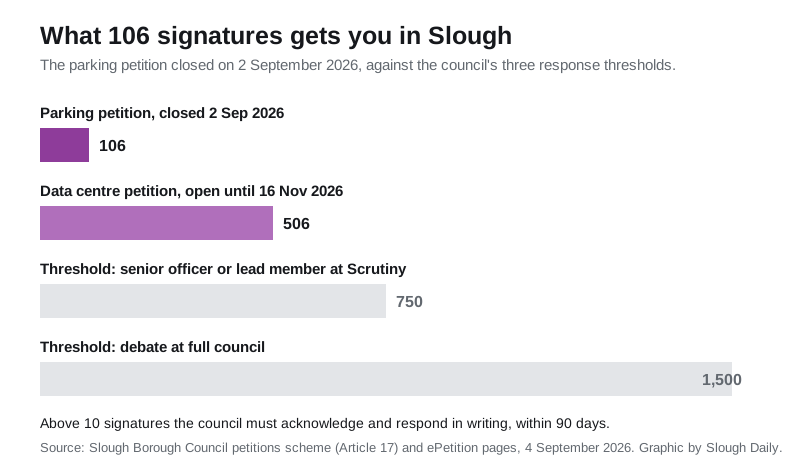
A petition asking Slough Borough Council to change the way it enforces parking at nine parks and leisure sites has closed with 106 signatures. It ran from 3 June to 2 September 2026 and has now finished. (Slough Borough Council ePetition 127)
Under the council’s own petitions scheme, that total triggers the lowest of three responses. A petition needs 1,500 valid signatures for a debate at full council and 750 to require a lead member or senior officer to give evidence at Overview and Scrutiny. Above 10, the council acknowledges it and responds in writing.
What the petition asked for
The nine sites are Salt Hill Park, Slough Ice Arena, Langley Leisure Centre, The Centre, Upton Court Park, Lascelles Park, Cippenham Recreation Ground, Harvey Park and Manor Park Recreation Ground. Charging began there on 27 April 2026 after a consultation that ran from 12 September to 3 October. (Slough Borough Council, 16 April 2026)
Each site keeps a free period of two, three or four hours. The council’s own announcement is explicit about the catch: “Residents will need to activate their free parking session through RingGo via the app, or over the phone, using the car park location code.”
The council’s entry for Salt Hill Park car park puts it in the same terms: “First 4 hours, free stay: you must still register the free stay through Ringo or PayPoint terminals in local shops.” After that it is £5 for four to six hours, £10 for six to ten hours and £20 for ten to twenty-four.
The petition’s argument is that the penalty therefore falls on people who owed nothing. It says a charge “of up to £100” can follow where a visitor “remained entirely within the free parking allowance and owed no parking fee”, so the charge “arises not from abuse of the parking facilities, but from administrative non-registration”.
It named older residents, disabled users, pregnant women, new mothers, parents with young children, NHS and public sector workers, and people with limited digital access as those most exposed, and argued the arrangement may sit badly with sections 20 and 149 of the Equality Act 2010.
Its nine requests were:
- automatic ANPR recognition, so free parking does not depend on manual registration
- linking free parking to membership and booking systems
- on-site tablets or kiosks for registration
- a six-month warning-only period for a first breach
- cancelling charges where a visitor can prove legitimate use within the free period
- better communication through staff, email, apps and on-site announcements
- requiring organisations that hire the venues to notify participants
- accessible alternatives for people who are digitally excluded
- publishing the enforcement data and the equality impact assessment
The PayPoint question
The council’s position is that anyone who cannot use RingGo can pay at a PayPoint terminal, and its council car parks page says those terminals are “usually within a five-minute walk of car parks”.
The petition disputes that. It says the nearest PayPoint “may be approximately ten minutes away on foot”, which “cannot reasonably be regarded as an accessible alternative for many vulnerable users”. Neither side publishes a site-by-site measurement, so the gap between the two claims is not resolved by anything currently on the record.
The petition also asked the council to publish figures it has not put out: the number of charge notices issued at each site since 27 April, how many were cancelled on appeal, total revenue, the equality impact assessment, the enforcement contracts and any first-time warning policy. None of those appear on the council’s website.
What happens next
The scheme sets out what the council owes a petition of this size:
- an acknowledgement, normally within 10 working days of receipt
- a response to the organiser setting out what the council intends, normally within 28 days of receipt
- a formal written response from the relevant director, within one month if possible and no later than 90 days, published on the council’s website
- a right for the organiser to request a review within 28 days of that formal response, if they think it inadequate
The council also reserves the right to verify each signature, so the 106 is a raw total rather than a confirmed one. A response published within 90 days of 2 September falls due by 1 December 2026.
The other live Slough ePetition, asking the council to pause new data centre development, has reached 506 signatures and runs until 16 November. It is also short of the 750 threshold, though with ten weeks left. We covered what that petition is asking for when it opened.
What it means for you
If you park at any of the nine sites, nothing has changed. The free period still has to be activated on RingGo or at a PayPoint before you walk away, or the stay is not free, however short it is.
Blue Badge holders park free all day, which the council states on each car park record, including Salt Hill Park. Our guide to parking in Slough sets out the tariffs, free periods and permit rules site by site.
If you have had a charge you believe is wrong, the petition process is not an appeal route and it never was. Challenge the notice itself, in writing, within the deadline printed on it, and keep evidence that you were using the facility inside the free period.
If you want to start a petition, the practical threshold to aim at is 750, not 1,500. That is the number that puts a lead member or senior officer in front of Overview and Scrutiny in public. Petitions need a minimum of 10 valid signatories with verifiable addresses, and signatories must live, work or study in Slough. Petitions started on sites such as change.org are accepted if they meet the scheme’s criteria, including names and addresses for verification.
Sources
- Protect Vulnerable and Law-Abiding Users from Unfair Parking Fines at Slough Community Facilities, Slough Borough Council ePetition 127
- Current ePetitions, Slough Borough Council
- Article 17, Petitions Scheme (PDF), Slough Borough Council constitution, May 2023
- Parking charges being introduced at parks and leisure sites, Slough Borough Council, 16 April 2026
- Council car parks, Slough Borough Council
- Salt Hill Park car park, Slough Borough Council car park directory
Have your say
We read every message. To comment on this story, email the newsdesk and we may publish a selection of responses: hello@sloughdaily.co.uk.