
Cabinet approved joining a Berkshire, Oxfordshire and Swindon body that will set how many new homes the area plans for, at £50,000 a year to Slough.
Slough has signed up to a new regional planning body that will eventually decide how much development the Thames Valley takes, and roughly where it goes.
Cabinet approved joining the partnership at a special meeting on Monday evening. The published decision records four resolutions, the first of which establishes a non-decision-making partnership with the councils covering Oxfordshire, Berkshire and Swindon.
The partnership exists to prepare a Spatial Development Strategy, or SDS. That is a new type of statutory plan created by the Planning and Infrastructure Act 2025. It sits above local plans and sets, in the words of the report to Cabinet, “the scale and broad distribution of development and associated infrastructure across multiple local planning authority areas”.
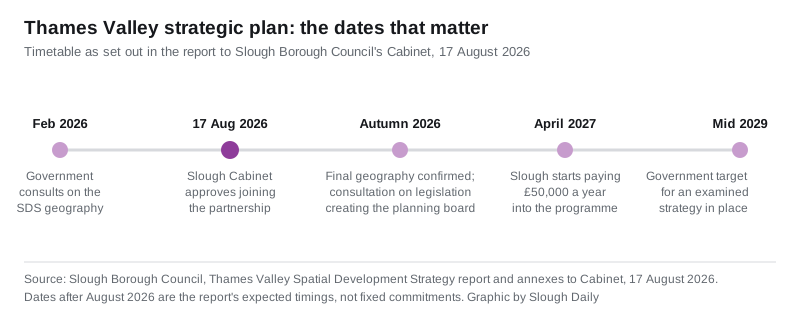
The government wants every part of the country to have an examined SDS in place by mid-2029.
Who is in the Thames Valley area
The government consulted in February 2026 on its preferred geography. For the Thames Valley, that covers:
- Bracknell Forest
- Oxfordshire
- Reading
- Slough
- Swindon
- West Berkshire
- Windsor and Maidenhead
- Wokingham
The report says the final geography is due to be confirmed in summer or autumn 2026, and lists uncertainty over that geography as a programme risk.
Nothing is decided yet, and that is deliberate
The legislation that would create the statutory body does not exist. Ministers are expected to bring forward bespoke secondary legislation in autumn 2026 to set up a Strategic Planning Board for the Thames Valley, with consultation expected around the same time.
Until then the partnership runs as a shadow board. The report is blunt about its limits. It has no formal decision-making powers, it is not a joint committee, and it cannot commit any council to anything. Contracts, spending above delegated limits and staff appointments still go through each council’s own constitution.
The report also says a formal decision on the board and on the strategy itself will come back to Slough Borough Council once the legislation is in place.
Its structure during the interim period is:
- a Partnership Board, with each council’s Leader on it
- a chief executives group, alongside the planning and place directors of every council
- a programme management office running day-to-day delivery and commissioning
- time-limited workstreams on governance, evidence, engagement and programme planning
What it costs, and what Slough pays
Bracknell Forest Council takes over as the accountable body for the money, and will host any staff the programme recruits. Oxfordshire County Council holds the first tranche of government funding at present. Oxfordshire’s councils are going through local government reorganisation, so the report recommends the role passes to an authority that is not being reorganised.
The indicative budget in Annex 1 covers a 30-month programme:
| Item | Amount |
|---|---|
| Resources and technical support | £2,393,000 |
| Commissioned studies, evidence and support | £1,725,000 |
| Contingency at 15% | £617,700 |
| Total estimated funding required | £4,735,700 |
Against that, the partnership currently has £764,000 of MHCLG grant funding, £300,000 of work-in-kind and £1,150,000 of local contributions from the councils, a total of £2,214,000. The report states plainly that the project “is also contingent on proposed additional MHCLG Funds of £2.5m”. The precise gap in the annex is £2,521,700.
Slough’s own share is £50,000 a year from 2027/28, to be met from the existing Planning Policy budget rather than new money. The annex puts every partner authority at about £50,000 from April 2027, with Oxfordshire paying £150,000 until reorganisation.
What it means for you
Nothing changes about how a planning application in Slough is decided today. Applications are still determined against the borough’s own planning policies, which currently means a Core Strategy adopted in 2008.
The live consultation is the local one, not this. Slough’s new Local Plan is open for comment until 24 August, and the council does not expect to adopt it until December 2028. That is only months before the government’s mid-2029 target for an examined Thames Valley strategy, so the two documents will be written largely in parallel.
What changes, in time, is the layer above. Once the Strategic Planning Board exists, two things move up a level. The number of homes Slough is expected to plan for would be settled regionally rather than borough by borough. So would the broad areas across the Thames Valley where growth is directed.
Slough is one of the most tightly bounded authorities in the group. It is a single compact urban borough with no rural hinterland of its own. Where a regional plan directs growth therefore matters here more than the borough’s size suggests.
There is no consultation to respond to yet. The two dates to watch are the confirmation of the final geography, expected in summer or autumn 2026, and the government’s consultation on the secondary legislation, expected in autumn 2026. A statement of readiness and a “strategic spatial baseline” mapping planned growth, constraints and opportunities across the area are among the first documents the partnership intends to produce.
One further caveat sits in the report. If a Foundation Strategic Authority is set up for the area, the Strategic Planning Board’s functions would be folded into it.
Sources
- Slough Borough Council, Thames Valley Spatial Development Strategy (SDS) Development and Governance, report to Cabinet, 17 August 2026
- Slough Borough Council, Annexes 1 to 3: funding, programme and governance
- Slough Borough Council, decision record: Thames Valley Spatial Development Strategy
- Slough Borough Council, Cabinet agenda, Monday 17 August 2026
Have your say