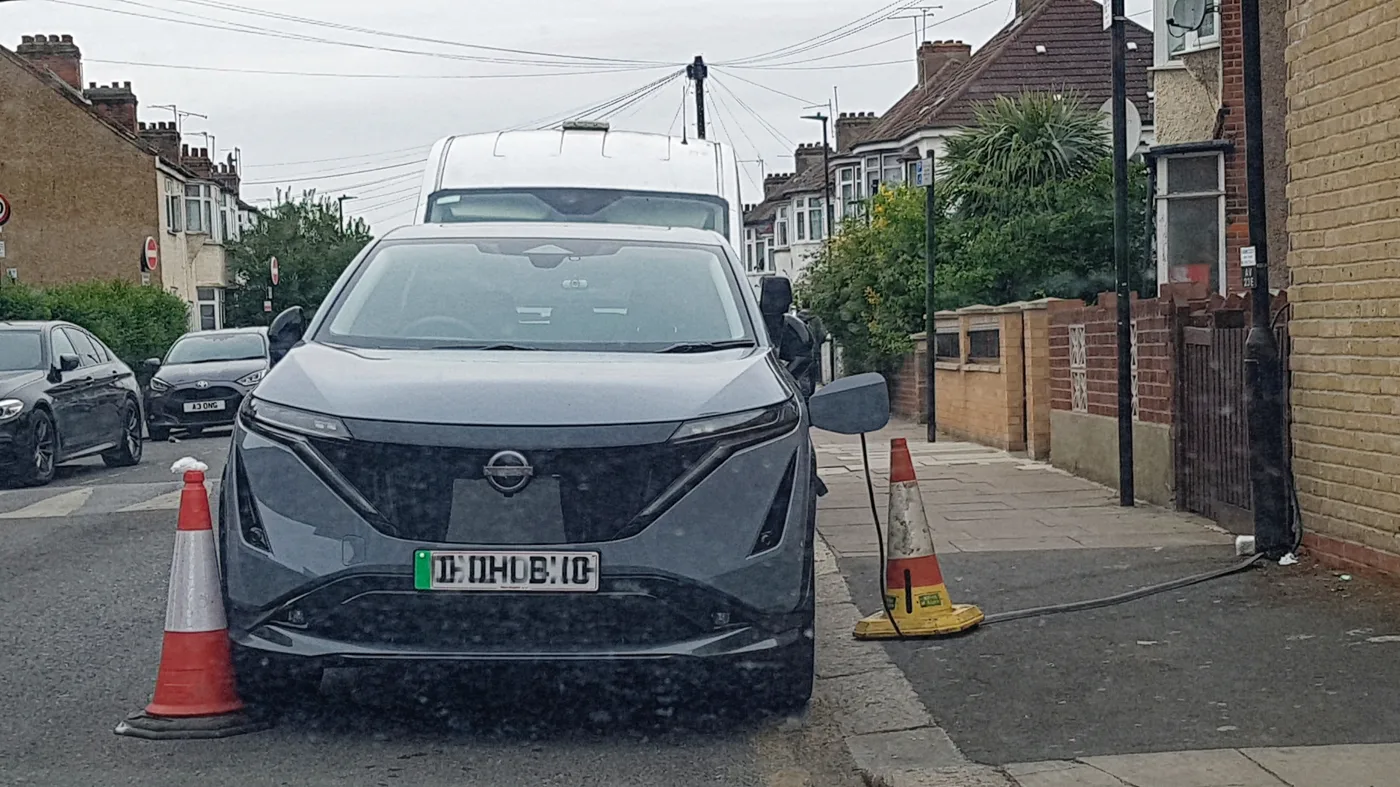

Slough has £130,000 from the DfT for 20 cross-pavement charging channels. Residents pay £399 and buy their own charger. The £4,000 saving claim needs a closer look.
The first cable channels were cut into Slough pavements on 12 August, opening a one-year trial that will let 20 households without a driveway charge an electric car from their own electricity supply. (Slough Borough Council, 18 August 2026)
A cross-pavement channel is a covered slot set flush into the footway. The lid opens, you lay your charging cable in it, and the lid snaps shut behind the cable so nothing is left proud of the pavement. It is the only method the council will approve for running a charging cable across a public footway.
Applications go through Kerbo Charge, the council’s partner for the trial. Once 20 are accepted, the rest go on a waiting list.
What it costs and what you have to supply
- £399 including VAT towards supply and installation, payable if your application is approved
- Your own wall-mounted charger, which the scheme does not cover and you have to arrange
- Either a local earth spike or a professionally installed charger with a built-in PEN fault device
- Public or third-party liability insurance, which Kerbo Charge checks as part of the application
More complex installations can cost more, and the council says any extra will be explained before work begins. Installation is aimed at within four weeks of council approval and payment. (Slough Borough Council, cross-pavement EV charging channels)
Whether your street qualifies
The council’s own guidance is blunter than the press release, and worth reading before you apply:
- You need to be able to park outside your home at least once a week. If not, it says this “may not be suitable for you”
- Parking bays cannot be reserved for individual properties
- The cable must not cross the carriageway, and your car must be on the same side of the road as your home
- Roughly 10 metres, about two car lengths from your property, is the recommended maximum
- A grass verge between house and pavement is “not normally recommended”, because of extra excavation and concrete
- You need a ground-floor electricity supply
The channel takes Type 2 cables up to 20mm across. It is rigid UV-stable PVC, tested to BS EN 1433 and carrying UKCA and CE marks.
Where the money came from, and that it has run out
Slough was paid £130,000 from the Department for Transport’s Electric Vehicle Pavement Channels Grant. That is confirmed in the Office for Zero Emission Vehicles’ own published allocations, which also record that Slough received no top-up. (OZEV, EV pavement channels grant funding amounts, updated 30 April 2026)
It is the largest award of any council in the area, and more than Buckinghamshire, an authority many times Slough’s size, received:
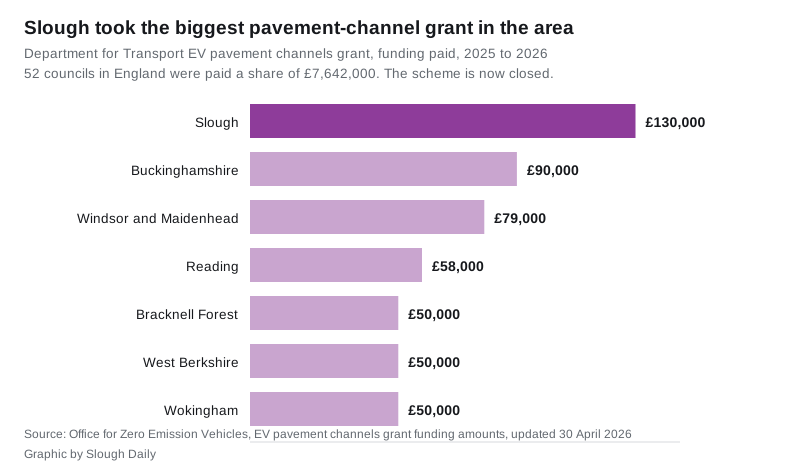
The same OZEV page carries a line the council’s announcement does not: “The scheme is now closed.” The £130,000 was a one-off from the 2025 to 2026 round.
Cllr Nadeem Khawar, lead member for environment and public realm, said the council hopes “the trial goes well and we can expand it further in time”. Any expansion will need a different source of money. The council has not said what that would be.
The £4,000 claim
The council’s release says a channel “could save residents around £4,000 per year compared to using public charging”. That figure did not originate with the council.
Kerbo Charge’s own Slough page words it differently: powering an EV at home “can unlock annual savings of up to £4,000 compared with public charging”, followed by a link to the company’s savings calculator. “Up to”, in the supplier’s marketing, has become “around” in the council’s press release. (Kerbo Charge, Slough)
The same page offers a way to test it. It says a home charge saves “around £25 per single charge compared to using public charge points”. Take both of the company’s own numbers together and £4,000 a year requires about 160 charges, or a full charge roughly every two and a half days, every week of the year. That is a heavy-mileage driver, not a typical one.
None of which makes the scheme bad value. Charging at home instead of at a public rapid charger genuinely saves real money, and £399 for the channel is a fraction of the £1,199 Kerbo Charge lists as its standard price. But the saving scales with how much you drive, and a household doing average mileage should not plan around £4,000.
The charger grant, and its deadline
The trial does not pay for your wall charger. A separate government grant might.
From 1 April 2026 the maximum chargepoint grant rose from £350 to £500 per socket, covering 75% of the cost of buying and installing it. Renters and flat owners apply themselves; landlords apply for up to 200 sockets. There is also a specific “households with on-street parking” grant in the same set. (Gov.uk, EV chargepoint grant for renters or flat owners)
The deadline is the part to note. All of these schemes have been extended for a final year and run only until 31 March 2027. Three related grants already closed to applications on 31 March 2026. (Gov.uk, Changes to EV chargepoint grant schemes from 1 April 2026)
What it means for you
- If you want one of the 20 places, apply now. After that it is a waiting list with no funded expansion behind it.
- Check the parking test honestly first. In Chalvey, Upton, central Slough and the terraced parts of Britwell, being able to park outside your own house once a week is the real hurdle, not the cost.
- Budget for two things, not one. £399 for the channel plus a wall charger, against which you can claim up to £500 if you qualify, before 31 March 2027.
- You carry the liability. The council’s guidance states you are responsible for any claim, damage or injury linked to your cable or channel, and your insurance gets checked.
- Do not assume £4,000. Work out your own mileage against what you currently pay to charge in public.
Queries about the scheme go to EnvironmentalQuality@slough.gov.uk.
Kerbo Charge co-founder Michael Goulden said the trial was “about giving residents more choice in how they charge their electric vehicle and helping remove the barriers that can put people off making the switch.”
The council’s environmental quality team will monitor the first 20 installations before deciding whether to widen the scheme.
Our Slough roadworks and travel page tracks current closures and footway works across the borough, including where pavements are being dug up.
Have your say