
Ending the two-child limit lifted 1,200 Slough children above the poverty line in May, the most in Berkshire. DWP figures show 6,100 children here gained.
About 1,200 children in Slough were lifted above the poverty line in May after the two-child limit on Universal Credit was removed, according to government figures. That is the highest number of any council area in Berkshire.
The Department for Work and Pensions published the figures on 17 November (DWP, impact of removing the 2-child limit, May 2026). They are the first actual counts since the limit ended in April 2026, rather than forecasts.
Overview
- 6,100 children in Slough lived in Universal Credit families whose award went up when the limit ended.
- 1,200 of those children were lifted above the poverty line as a result, about one in five.
- 2,720 adults in Slough were in families whose award rose, and 520 were lifted above the poverty line.
- Most in Berkshire: Slough accounts for about a third of the county’s children lifted out of poverty.
What the figures count
Until April, most Universal Credit families got the child element for their first two children only. Since April, families can receive it for every eligible child, the DWP said.
The department used Universal Credit records for assessment periods covering 14 May 2026. It worked out how much each affected family’s award rose and whether that took the family over the poverty line.
Poverty here means relative low income after housing costs: household income, adjusted for family size, below 60% of the national median once rent or mortgage is paid. All figures are rounded to the nearest 10.
Slough against the rest of Berkshire
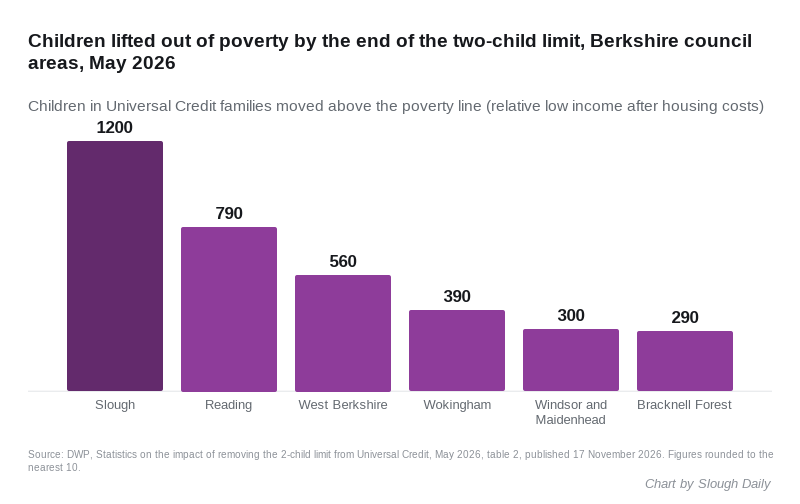
Slough had more children helped than any other Berkshire council area, by a wide margin. Reading was next, with 790 children lifted out of poverty.
| Council area | Children whose award rose | Children lifted out of poverty | Adults lifted out of poverty |
|---|---|---|---|
| Slough | 6,100 | 1,200 | 520 |
| Reading | 3,770 | 790 | 300 |
| West Berkshire | 2,590 | 560 | 220 |
| Wokingham | 1,990 | 390 | 160 |
| Windsor and Maidenhead | 1,850 | 300 | 120 |
| Bracknell Forest | 1,610 | 290 | 110 |
Across the six areas, 17,910 children were in families whose award rose and 3,530 were lifted out of poverty. Slough’s share of each is about 34%.
The same tables give figures by parliamentary constituency. The Slough constituency, which does not cover the whole borough, had 5,290 children in families whose award rose and 1,040 lifted out of poverty.
Across Great Britain, 1,568,480 children were in families that gained, and 301,720 were lifted above the poverty line.
Reading the numbers
A child is only counted as lifted out of poverty if the extra money moved the family over the line. The DWP tables do not say how many of the other children whose award rose were already above it and how many are still below it.
The figures sit alongside other signs of pressure on household budgets here. Slough has the highest claimant rate of any council area in the South East: 6.0% of working-age residents in October.
What it means for you
- If you get Universal Credit and have three or more children, your award should already include the child element for each eligible child. You can check your payment statement in your Universal Credit account.
- The DWP says the figures leave out some income, including child maintenance and council discretionary payments, so they are an estimate of the effect rather than a full picture of family income.
- The department says no further releases of these tables are planned.
Have your say