
Slough's economy grew 25% in eight years but jobs did not keep pace, the council's draft growth strategy says. Have your say on the plan by 3 November.
Slough’s economy is growing much faster than the number of jobs in it. That is the central finding of the council’s draft Economic Growth Strategy, which is now open for comment until 3 November.
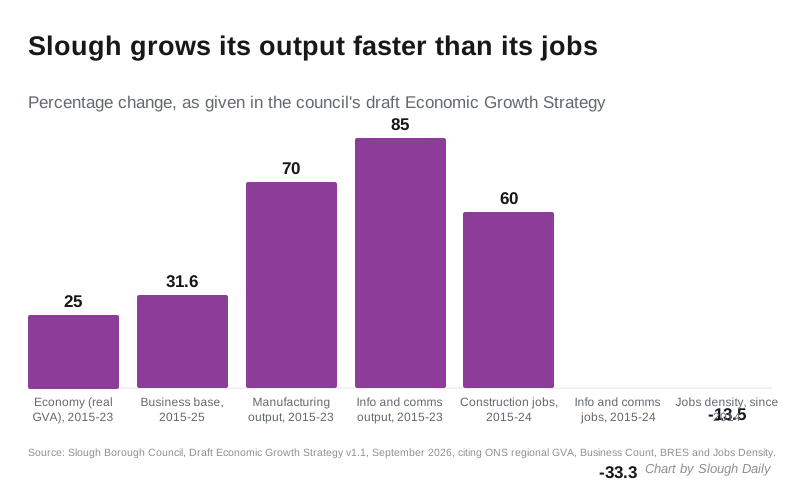
The strategy says the borough’s economy grew by about 25% in real terms between 2015 and 2023, more than London, the South East or England. Over a similar period, jobs density fell by about 13.5%. In plain terms, the number of local jobs has not kept up with the number of working-age residents.
The figures come from the draft strategy itself, version 1.1, dated September 2026. It runs to 2040 and sets a vision for 2050.
The gap between output and jobs
The draft is frank that growth has not reached everyone. Its own numbers show the split:
| Measure | Change | Period |
|---|---|---|
| Economy (real GVA) | up about 25% | 2015 to 2023 |
| Business base | up 31.6% | 2015 to 2025 |
| Manufacturing output | up about 70% (England: about 5%) | 2015 to 2023 |
| Information and communication output | up about 85% (England: 60%) | 2015 to 2023 |
| Information and communication jobs | down 33.3%, from 9,000 to 6,000 | 2015 to 2024 |
| Construction jobs | up 60% | 2015 to 2024 |
| Jobs density | down about 13.5% | since 2014 |
The fall in information and communication jobs happened while the same sector grew its employment by about 19% across England. A footnote says the decline covers the broad sector, not data centres alone. It adds that data centres “generate relatively few direct jobs compared with the scale of their output, capital investment, energy use and infrastructure footprint”.
Elsewhere, the draft’s opening pages cite an industry report by the data centre operator KAO Data, which credits data centres with “14,000+ jobs” in Slough. The draft does not reconcile the two. We covered the latest large data centre plan, at Manor Farm West in Poyle, last month.
What the draft says about residents
The strategy sets out the strain on households alongside the strong output figures:
- Unemployment is around 7.4%, more than double the South East rate of 3.6%.
- Skills are not the main problem: 47.7% of working-age residents are qualified to higher education level, RQF level 4 or above.
- Healthy life expectancy is about 58.1 years for men and 60.3 for women, against 63.1 and 63.9 across England.
- Homelessness stands at 10.1 per 1,000 households, above England (7.5) and the South East (5.3).
- Temporary accommodation: Slough has the seventh-highest rate nationally and the highest outside London.
- Deprivation is concentrated in Britwell, Chalvey, Elliman, Slough Central and Wexham Court. Slough is the 53rd most deprived of 153 local authorities.
It also records residents’ complaints about “infrequent and unreliable buses”, poor links to Heathrow and high fares.
What the council proposes
The plan is built on three pillars, People, Place and Enterprise. Its headline actions include:
- a Slough Opportunity Guarantee, so every young person can get careers advice, work experience, mentoring and apprenticeship routes through schools, colleges and employers
- joined-up routes into work that bring health, skills, housing and childcare support together
- more affordable homes and less reliance on temporary accommodation
- better local transport links to jobs, including Heathrow, through a refreshed Transport Strategy
- a Slough Employer Charter on local recruitment, apprenticeships and good work
- opening council and major-project spending to Slough businesses
- “local-benefit commitments” written into major investments
The draft’s measures of success for 2035 are written as directions, such as “more residents in work” and “fewer households in temporary accommodation”. It does not set numerical targets. It promises a monitoring framework with annual reporting.
The council will not deliver every action itself. The draft says it will convene partners through a proposed Slough Growth Partnership.
What the council says
Councillor Wal Chahal, leader of the council, said in the council’s announcement: “We want our economy to build on these strengths to create more good jobs, clearer and more visible skills and progression pathways for young people, and greater opportunities for local businesses and residents.”
What it means for you
- Have your say: the online survey is open until 3 November and takes 10 to 15 minutes, the council says. Questions can go to the Economic Development team at invest@slough.gov.uk.
- Young people and parents: the Opportunity Guarantee is the part of the plan aimed at under-25s. The draft cites a survey in which 57% of young people said access to employment opportunities was “not going well”.
- Local businesses: the procurement and Employer Charter proposals affect who wins council and big-project contracts.
- Housing: the strategy ties jobs to the temporary accommodation problem. Our earlier report on the council’s temporary accommodation strategy has the detail.
The council has not published a date for adopting the final strategy. We will report what happens after the consultation closes.
Have your say