
Slough children entering the youth justice system for the first time rose 57% in a year. The service is still under intensive Youth Justice Board support.
The number of Slough children entering the youth justice system for the first time rose by 57% in a year, according to the council’s own three-year plan for the service.
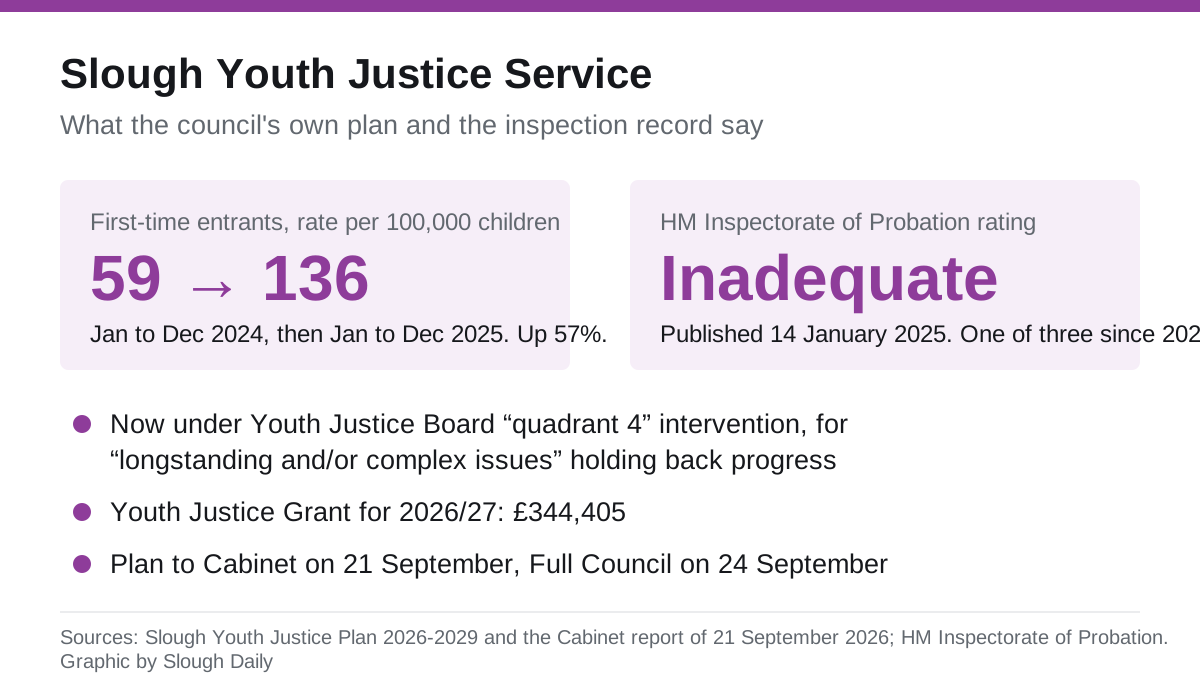
The plan goes to Cabinet on Monday and to Full Council on Thursday. It records that Slough’s first-time entrant rate went from 59 per 100,000 children in the year to December 2024 to 136 in the year to December 2025. The rise has continued into 2026, though the plan says the rate of increase has slowed to 28%.
A first-time entrant is any child aged 10 to 17 receiving their first substantive outcome: a youth caution, a youth conditional caution or a court sentence.
Slough went up while everywhere around it came down. The plan states plainly that “the Slough rate has increased whereas the rates for all other comparators decreased”, and singles out Thames Valley, where the direction of travel is the opposite. Slough’s rate is still below the regional and national rates, and the borough ranks fifth lowest for first-time entrants among the twelve councils in its statistical family group.
The plan expects the number to get worse before it gets better. It warns of “further negative impact on our rates” from two changes outside the council’s control: Thames Valley Police guidance on children who give no-comment interviews, and new national knife guidance.
The service is still under the toughest tier of national support
The sharper finding is not in the plan. It is in the covering report to Cabinet, which states that the Youth Justice Service “has also been identified as requiring more intensive support from the YJB through Quadrant 4 intervention, which highlights ‘longstanding and/or complex issues that are preventing agreed improvement progress’”.
That is 20 months after HM Inspectorate of Probation rated the service Inadequate. The inspectorate published that report on 14 January 2025, after fieldwork in September 2024, and said at the time it was only the third Inadequate rating given to a youth justice service since 2020.
The Chief Inspector of Probation, Martin Jones, said then that “a lack of stability at Slough YJS has resulted in some significant deficits in service delivery”, and that a “fragile and limited understanding of youth justice practice at management board level” had left the service unable to provide the interventions needed to support desistance and protect the public.
Inspectors described the gap in work with victims as a “systemic weakness”. The two posts covering victims, restorative justice and reparation had been vacant for almost a year, with no effective mitigations in place. The report made 10 recommendations: five for the service, four for its management board and one for the Probation Service.
What scrutiny told the council in July, and what Cabinet is agreeing
Councillors on the Corporate Improvement Scrutiny Committee looked at the improvement plan on 21 July 2026 and sent four recommendations to Cabinet. Cabinet is being asked to agree all of them, and its written responses are more revealing than the recommendations.
- On measuring progress, Cabinet’s response accepts that “the current Improvement Plan is based on outputs rather than outcomes”, and says work is now under way to add key performance indicators and merge it with the annual youth justice plan.
- On the voice of the child, including children with SEND, the response says the current format “does not provide scope to capture the progress and outcomes achieved”.
- On progress generally, Cabinet agrees there has been improvement, “from a very low base”, in staffing and restorative justice training, data and performance reporting, assessments, and the child’s voice.
- On partnerships, planning has started alongside post-ILACS planning for children’s social care.
The lead member is Councillor Puja Bedi, and the responsible chief officer is Debbie Jones, who is both the council’s Executive Director of Children’s Services and chief executive of Slough Children First, the council-owned company that runs the service.
The seven things the service has promised to do
The plan sets seven priorities for 2026 to 2029, with numbers attached to four of them:
- cut the first-time entrant rate by 30% within 12 months, with further falls over the three years
- raise the share of children in education, training or employment from 60% to 80% in a year
- increase victim engagement with restorative justice by 25% in year one and 50% by year three
- reduce ethnicity-related disproportionality “towards representative levels”
- embed participation and co-production with children and families
- embed quality assurance across the youth justice system
- strengthen the Youth Justice Management Board and its partnerships
The rest of the picture, from the same document
The plan is not all bad news, and the figures cut both ways.
- No child from Slough has received a custodial sentence since 2022.
- Offences committed by children fell 16% in the past year, and violence against the person, still the largest category, has fallen year on year since 2023/24.
- Reoffending is the service’s strongest number. Among its twelve-council family group, Slough had the lowest reoffending rate in the year to June 2024 at 10.8%, down from 27.6% the year before. The plan describes that as “a decrease of 155%”, which cannot be right as a percentage fall; the two rates it publishes are the reliable figures.
- 92% of children open to the service were known to children’s social care in 2024/25. Children in the council’s care made up 14% of the cohort, six points down on the year.
- 79.6% are boys, most aged 15 to 17, with a slight increase in referrals of children under 16.
- Children not in education, employment or training are rising, to 40%.
- Victims consent to contact at a high rate, 91.2%, but only 41.9% go on to take part in restorative processes at initial contact.
Slough has the second highest proportion of children and young people in England: about 43,800 under-18s, 28% of the population, of whom more than 70% are from global majority backgrounds, speaking over 150 languages and dialects.
The Youth Justice Grant for 2026/27 is £344,405. The report says the plan will be delivered from existing budgets, partnership contributions and grant funding, with no new financial commitment, and warns that failing to meet the statutory requirements “could place grant funding at risk”.
What it means for you
Approving the plan is a legal duty, not a choice: section 40 of the Crime and Disorder Act 1998 requires the council to produce one every year, and it was already submitted to the Youth Justice Board on 30 June 2026 with the management board chair’s approval, ahead of councillors seeing it.
What is worth watching is whether the numbers in it move. The council has now written down a 30% cut in first-time entrants within 12 months, and has accepted in writing that its improvement plan measures activity rather than results. Those two things can be checked against each other next year.
Both meetings are public. Cabinet meets at 6.30pm on Monday 21 September in the Council Chamber at Observatory House, 25 Windsor Road, SL1 2EL. Full Council meets at 7pm on Thursday 24 September, with the Youth Justice Plan listed as item 7.
The council’s separate children’s social care failings are covered in our report on the Ofsted inadequate judgement, and what the council is spending is in our report on the £19.9m overspend forecast.
Sources
- Slough Borough Council, Youth Justice Plan 2026/27 report to Cabinet, 21 September 2026 for the Quadrant 4 intervention and its definition, the £344,405 grant, the statutory duty, the 30 June 2026 submission, the lead member and chief officer, and the seven priorities with their targets.
- Appendix A, Slough Youth Justice Plan 2026-2029 for the first-time entrant rates of 59 and 136, the 57% and 28% increases, the comparator statement, the family group ranking, the police and knife guidance warning, the custody, offending, reoffending, social care, gender, NEET and victim figures, and the borough’s child population.
- Appendix B, recommendations to Cabinet from the Corporate Improvement Scrutiny Committee for the 21 July 2026 recommendations and Cabinet’s written responses.
- HM Inspectorate of Probation, “Significant deficits” at ‘Inadequate’ Slough Youth Justice Service, published 14 January 2025, for the rating, the Chief Inspector’s words, the victims “systemic weakness”, the 10 recommendations, the September 2024 fieldwork and the four-point rating scale.
- HM Inspectorate of Probation, An inspection of youth justice services in Slough for the report itself.
- Slough Borough Council, Cabinet agenda, 21 September 2026 and Council agenda, 24 September 2026 for the times, the venue and the agenda item.
Have your say